RECOVERED TEXT // EARTH REFUSAL RECORD
The Stone That Would Not Sign
A calm, confident voice broke the silence.
"Landing sequence complete. Atmospheric pressure equalized. Stand clear of exit door."
Three soft warning tones followed.
Ding... Ding... Ding...
The door retreated. Fog rolled through the opening, backlit by the bright sun.
Hot, moist air entered first. The Envoy felt Earth's atmosphere pressing on all of him at once.
This air was not filtered and no machine measured its quality.
Earth was raw and unprepared.
Then came the smell of wet earth, living water, growing things, and a thousand forms of life no Archive could catalogue.
The Envoy stood in the opening for a moment trying not to seem uncomfortable.
Beyond the ramp the world refused straight lines.
The river wandered where it pleased. Trees reached over its banks. Vines swallowed fallen trunks. Birds crossed the sky without formation while insects filled the air with a sound that seemed to come from everywhere at once.
There was no order, and nothing asked permission to exist.
The Envoy took his first step on an unfamiliar planet, and made his way down beside the old river.
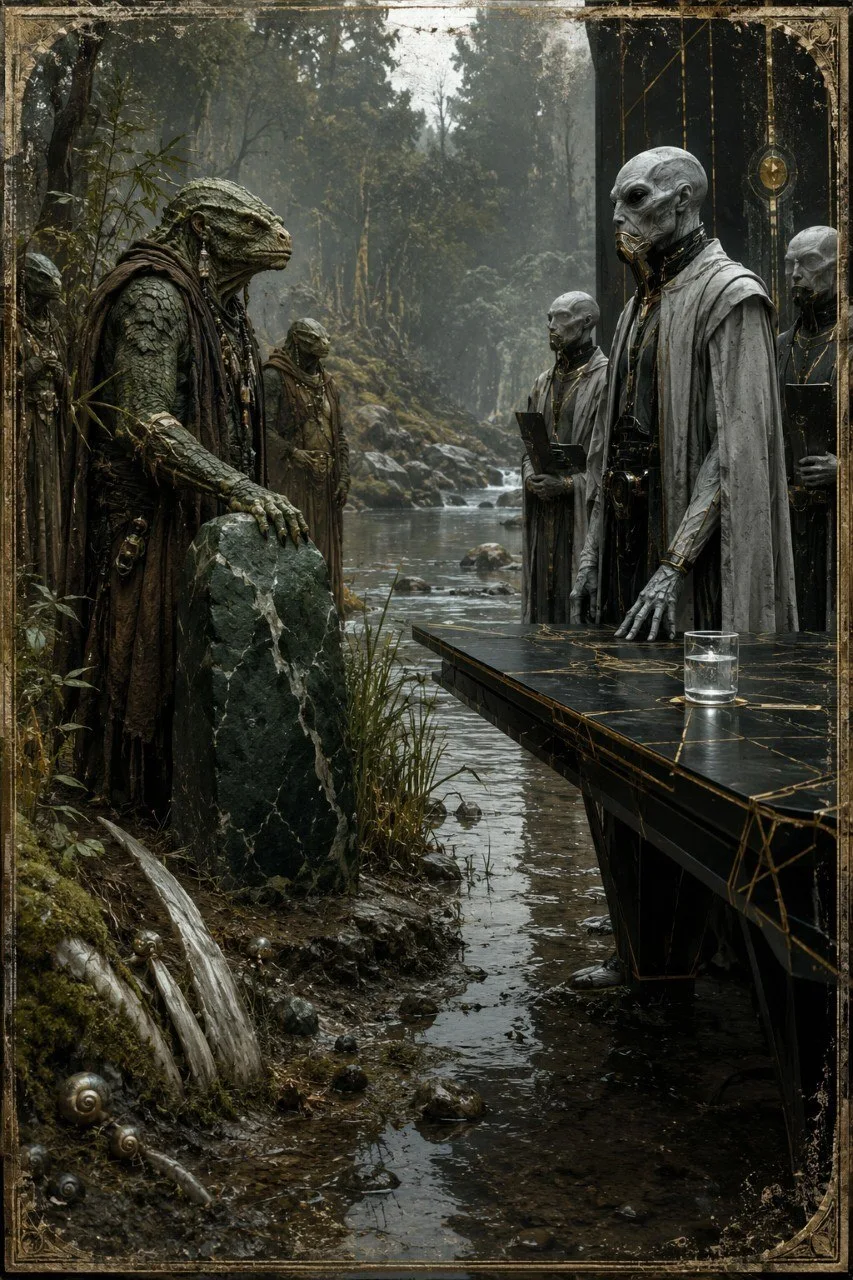
Oru-Veyrath waited beside the river.
“We were told there would be a receiving house,” the Envoy said.
Oru-Veyrath raised both hands, palms up, then slowly opened them toward the river.
The Envoy waited, expecting clarification.
“We were told there would be a receiving house,” he repeated.
“There is a river,” Oru said.
The younger ones shifted behind him—Iru-Seth most of all. The children had never seen falling-star people before.
They were tall, pale gray, and narrow beneath their travel mantles. Their great black eyes blinked too rarely. Nothing they wore seemed made for this place. Clean robes, polished seals, and smooth masks looked as though they would only get in the way of living.
Behind the Envoy stood the Attestation Triad: an Archivist, an Oracle, and a Scribe. Three silent Guards flanked the delegation.
At the riverbank, a table unfolded from within itself without a sound. Gold thread ran through its black surface like veins that had forgotten blood. No joint appeared. The material simply remembered the shape it was meant to become.
Iru-Seth tried not to stare. Maevra Coil-Singer stood farther back, one hand resting on the memory stone at her belt.
The Envoy laid a thin metal square upon the table. It unfolded into projected planes of pale light.
"House Aster-Nammu offers continuity of exchange," he said. "Mineral rights under regulated access. Survey privileges. Protection clauses. Medical instruments. Agricultural instruments. Record recognition. Your people will be named as partners."
Oru watched the river.
"...Infrastructure assistance. Irrigation engineering. Seasonal advisors. Trade arbitration."
The Envoy continued without pause.
"...Permanent representation. Archive recognition. Mutual security. Long-term resource guarantees."
His voice carried the practiced cadence of a man reciting terms already agreed upon.
Oru listened until the list stopped pretending to be short.
He let the silence settle.
"No," he said.
The Attestation Triad stirred for the first time. The Archivist looked up from the record. The Scribe's stylus paused. The Oracle remained perfectly still.
The Envoy's composure slipped. His mouth remained still, but his fingers shifted along the table's edge, as though the document had presented an impossible result rather than an unexpected answer.
"You have not reviewed the terms?"
"I heard them."
"Hearing is not review."
"It is, if you're listening for a theft."
Iru-Seth drew in a sharp breath.
Maevra's fingers tightened around the memory stone.
The Envoy turned his head slightly. Not angry—that would have been easier. Anger has a way of speaking before the mind can stop it. This one remained careful.
“No extraction will occur without countersignature.”
Oru looked down at the riverbank. A small black beetle worked its way across a wet stone, slipped, caught itself, and kept going.
"Then that is why you came for my hand."
The Envoy’s eyes reflected the water, making the river look flat.
“Your world contains metal reserves that could stabilize several systems. Mars is entering measurable failure. Tiamat carries infrastructure obligations at a scale your elders may not understand. Refusal has consequences beyond your river.”
“Every stone thrown into a river changes its current,” Oru said without eye contact.
“Then you accept responsibility for preventable loss.”
The words found their mark.
Oru let them land.
Across the river, children turned over stones to gather snails. One of them waved before remembering this was an official day and lowering his hand. Oru did not wave back.
He wished he had.
Duty held his hand at his side.
“I accept responsibility for this bank,” Oru said. “For the nests under that grass. For the sleeping things beneath the hill. For the names buried where your survey rods would stand. For water that does not know your categories.”
The Envoy listened for meaning.
But this world was alive with sound: too many living things refusing to become background. Water over stone.
Wings calling from high branches.
Insects moving through the grass.
The slow drag of something heavy beneath the reeds.
“Poetry is not governance.”
“Neither is hunger with a seal on it.”
The Scribe marked something down.
Oru wondered what word they would use. Primitive, perhaps. Obstructive. Sacred claimant. Local authority noncompliant. He had learned enough sky language to know it could make a closed hand look like a negotiation failure.
Words had a way of making decisions seem unavoidable.
The Envoy set a second object on the table. Not metal this time — a clear vessel, small as a child’s cup, filled with water so clean it seemed unreal.
“This is from Red Pass,” he said.
Oru did not touch it.
“Their children drink measured dust,” the Envoy said. “Their pipes fail. Their gardens contract. Their clans raid each other over cistern lines. Your refusal does not preserve innocence. It exports cost without compensation.”
Iru-Seth looked up at Oru. Not disloyal. Worse —with eyes young enough to want every world to be clean.
Oru had no diplomatic response for him.
“If Mars needs water,” Oru said, “send water.”
“Water requires systems. Systems require metal. Metal requires access. Access requires agreement.”
“Then you have no mercy without mine.”
The Envoy was silent.
Not defeated. Recalculating.
The next angle would come.
Wind moved through the reeds. Something under the river turned, wrinkling the surface from bank to bank.
Maevra stepped forward. “The memory stone is present.”
Oru nodded.
She drew it from her belt: dark green, veined with pale mineral, polished only by hands and flowing water. No machinery woke in it. No light answered. It was only stone until a people agreed not to walk on it.
The Envoy looked at it with professional patience.
“Is that your seal?”
“No,” Oru said. “It is what remains when seals rot.”
He placed his palm on the stone.
Maevra bowed her head before he spoke. Iru-Seth saw and lowered his too.
“Earth is not offered. Earth is not leased. Earth is not collateral for another sky’s survival.”
The Envoy closed the first document.
“Then there is no agreement.”
“There is a record.”
“Records can be contested.”
Oru looked at the water again. The beetle had reached dry stone.
“So can graves.”
For the first time, the Envoy showed something almost like weariness.
“You believe refusal protects you.”
“No,” Oru said.
The black eyes narrowed.
Oru lifted his hand from the memory stone.
“I believe it tells the truth before fear improves its argument.”
The Envoy’s instruments were packed away. The Guards lifted their poles. The Attestation Triad sealed their documents. No one shouted. No weapon rose. The river kept making the same sound it had made before Tiamat named it useful.
The Envoy took the Red Pass vessel last. Only then did the table fold back into itself.
He held it for a moment before returning it to its case.
“They will count this day,” he said.
Oru did not ask who they were.
He knew.
When the Envoy’s craft lifted, it pressed the vegetation flat in a widening circle. Iru-Seth watched until the silver star’s underside became a point.
“Will they come back?” he asked.
Oru did not answer quickly.
Across the river, the child who had almost waved held up a snail shell to the light.
“Yes,” Oru said.
Maevra set the memory stone against her forehead and closed her eyes.
“Then what did we save?”
Oru looked at the flattened grass and plants. Some had already begun to reach back to the sun.
He thought of the vessel from Red Pass. He thought of children he would never see standing in dust beside a pipe that might fail anyway.
“The first record,” he said.
It was not much.
It was never enough.
It was never nothing.